The short answer
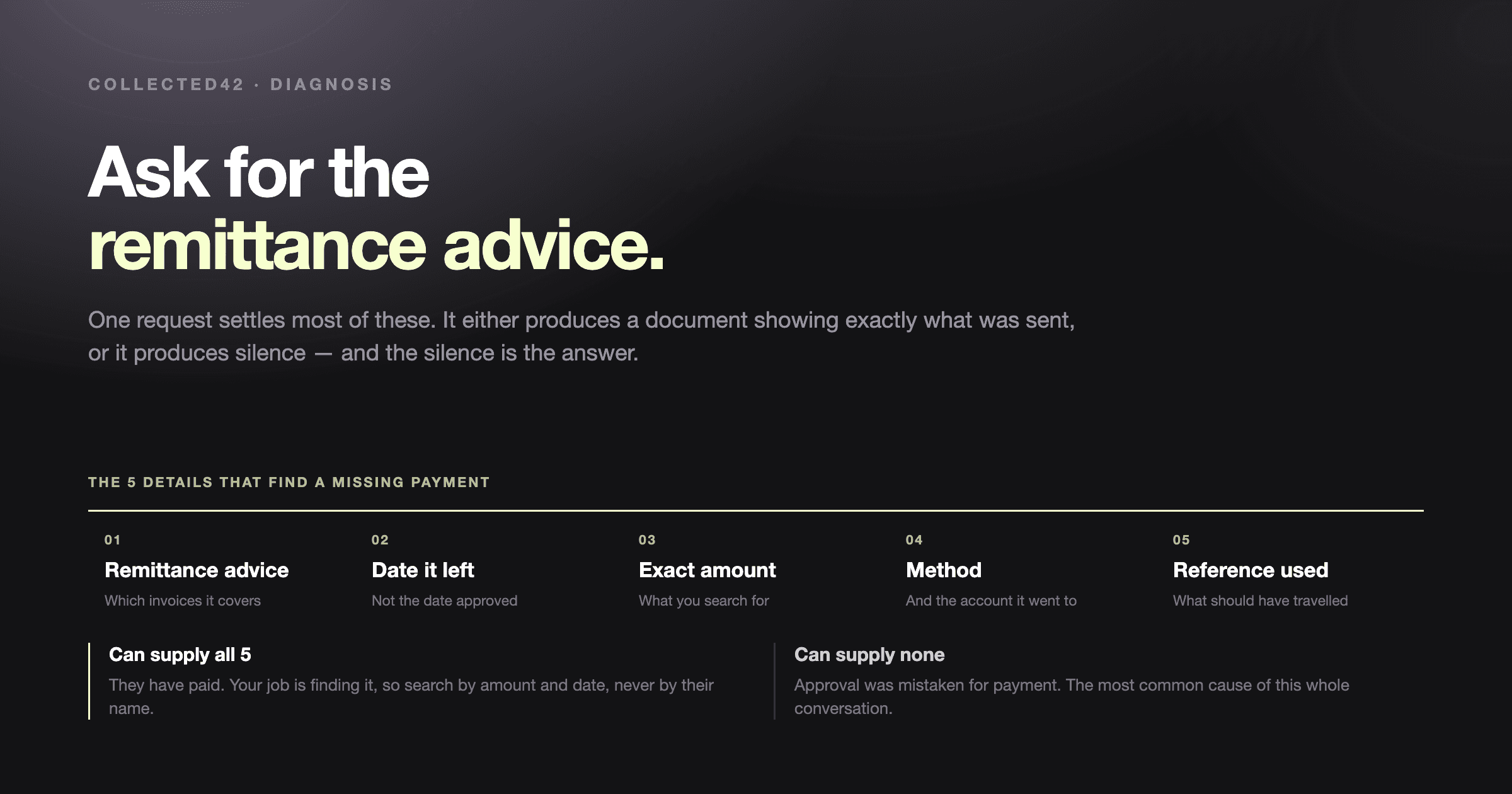
Ask for the remittance advice. That 1 request resolves most of these, because it either produces a document showing exactly what was sent and when, or it produces silence, and the silence is itself the answer.
Request the remittance advice, the payment date, the amount and the method.
Search your account by amount and date rather than by the client's name.
Check whether it arrived short, which is usually a fee rather than a shortfall.
Check it was not paid to an old account or a different entity of yours.
Treat a confident claim with no evidence as the beginning of a different conversation.
Most of the time the money is real and something broke between their system and your bank statement. Sometimes the payment was approved rather than sent. Occasionally it went somewhere else entirely, and that case is serious.
What to ask for, exactly
Vague questions get vague answers. Ask for 5 specific things in 1 message, and most finance teams will send a remittance advice back without further discussion:
The remittance advice, which is the document their system generates listing the invoices a payment covers.
The date the payment left their account, rather than the date it was approved.
The exact amount sent, which is the number you search your statement for.
The method and the account it went to, including the last few digits.
The reference used, since that is what should have travelled with it.
A client who can supply all 5 has almost certainly paid, and your job turns into finding it. A client who cannot supply any of them has usually confused approval with payment, which is the single most common cause of this conversation.
The 8 reasons the money is not in your account
What happened | How you spot it | What fixes it |
|---|---|---|
Approved, not sent | They cannot give a payment date | Ask which payment run it is in |
Paid with no reference | The amount is there, unmatched | Search your statement by amount |
Paid to an old account | Your old bank shows it | Confirm current details in writing |
Paid to a different entity of yours | Another company of yours received it | Reconcile across entities |
Arrived short | The amount is close but lower | Compare the gap to likely bank fees |
Deducted deliberately | A round sum is missing | Ask what the deduction relates to |
Paid a consolidated amount | 1 payment covers several invoices | The remittance advice allocates it |
Paid to a fraudulent account | They have a receipt, you have nothing | Act immediately, see below |
The first row accounts for more of these than the rest combined. Inside a client, an invoice being approved feels like it has been paid, and the person telling you it is paid is often reporting what their screen said rather than what their bank did. The way through is the question in what to do when finance is handling it: which payment run, on what date.
The second row is the quiet one. The money is sitting in your account unallocated, you have been following up an invoice that was settled 3 weeks ago, and nobody is wrong except the process.
Why references go missing
Payment systems carry a limited amount of information alongside the money, and whatever a client types into their banking screen does not always survive the trip.
In the euro area the limit is explicit. The European Payments Council's SEPA Credit Transfer Rulebook provides for a remittance field carrying up to 140 characters, structured or unstructured, and states that this field is what enables automated reconciliation between receivables and payments by the beneficiary. 140 characters is enough for an invoice number and little else, so a client listing 6 invoices in it will lose most of them.
In the US the position has improved recently. Federal Reserve Financial Services announced in July 2025 that the Fedwire Funds Service had completed its migration to the ISO 20022 message format, which provides a richer set of payment data and supports businesses in automating their processes and improving straight-through processing. Richer structured data means fewer payments arriving with nothing attached, though only where both banks use it well.
None of which helps on the day. What helps is searching your statement by amount and date rather than by the client's name, because the name is frequently the parent company, a payment processor or an abbreviation you would never recognise.
When it arrives short
A payment close to the invoice but slightly lower has 3 usual explanations, and they call for different responses:
Bank fees. An international wire sent with shared charges has intermediary deductions taken in transit, which is covered in getting paid by a client in another country. A gap of a few tens of dollars on an overseas payment is almost always this.
A deliberate deduction. A round number missing usually means the client has withheld something on purpose, for a credit they believe they are owed or a cost they are passing on. Ask what it relates to, in those words.
A partial payment against a disagreement. Where they have paid the part they accept and held the part they do not, you have a dispute rather than a short payment, and the undisputed portion arriving is actually good news.
Do not write off a shortfall silently. A deduction nobody questions becomes a precedent, and the next one is larger.
The case that needs acting on today
Occasionally a client has genuinely sent the money, has a bank confirmation, and it is not in your account and never will be. The usual cause is invoice fraud: someone intercepted or spoofed an invoice and substituted their own bank details, and the client paid those details in good faith.
If the evidence points that way, speed matters more than anything else in this article:
Tell the client immediately and ask them to contact their bank to attempt a recall. Recoveries are possible in the first hours and rare after that.
Report it to your own bank, and to the police or the relevant national fraud body.
Preserve the emails, including full headers, before anything is deleted.
Check whether your own email was compromised, since that is a common route in.
Prevention is unglamorous and effective: never accept a change of bank details by email, from either direction, without confirming by phone on a number you already had. Treat an emailed request to update payment details as suspect by default, however ordinary it looks, and tell your clients you work that way so they expect the call.
The reply to send
Neutral, specific, and written so that it is easy to answer:
Subject: Invoice #214 — confirming receipt
Hi [Name],
Thanks for confirming that was paid. I can't locate it on our side yet, so could you send the remittance advice when you have a moment?
If it's easier, these 4 details would let me find it: the date the payment left your account, the exact amount, the method, and the last 4 digits of the account it went to.
It may well be sitting here unallocated, in which case I'll match it and close this off today.
Thanks,
[Name]
The last line matters. Offering the possibility that the fault is yours keeps the exchange cooperative and costs you nothing, and roughly a third of the time it turns out to be true.
Making it rarer
Most of these are preventable with 3 habits:
Put the invoice number where it will travel. State it on the invoice as the payment reference, in those words, so whoever types it knows what to type.
Match receipts weekly, not monthly. An unallocated payment found in week 1 is an administrative note. Found in week 6 it has already generated 3 unnecessary reminders, which is part of what the weekly review is for.
Keep bank details in 1 place and never change them by email. Sending invoices from a shared billing address helps, because the details live with the function rather than with a person.
Agreeing the payment method at the start helps too, since the methods differ in how much information they carry. The comparison is in how clients should actually pay you.
FAQ
A client says they paid but I have not received it. What do I do?
Ask for the remittance advice, the payment date, the exact amount, the method and the account it went to. Then search your own statement by amount and date rather than by the client's name, because the name on the payment is often a parent company or a processor.
What is a remittance advice?
A document the payer's system produces listing which invoices a payment covers. It is the fastest way to resolve a disputed receipt, and a finance team can usually send one in minutes.
Why would a payment arrive with no invoice number?
Because payment messages carry limited information and whatever was typed may be truncated or omitted. A SEPA credit transfer carries up to 140 characters of remittance data, which covers 1 invoice number comfortably and 6 not at all.
The payment is slightly less than the invoice. Why?
Usually bank fees on an international transfer sent with shared charges. A round number missing instead suggests a deliberate deduction, which is worth asking about directly rather than absorbing.
What if the client paid a fraudulent account?
Act immediately. Ask them to contact their bank about a recall, report it to your bank and to the relevant fraud authority, and preserve the email trail. Recovery chances fall sharply after the first hours.
How do I stop this happening repeatedly?
State the invoice number as the payment reference on the invoice itself, match incoming payments weekly rather than monthly, and never change bank details by email without confirming by phone on a number you already had.
Not legal or financial advice. If you suspect payment fraud, contact your bank and the relevant authorities immediately and take professional advice.