The short answer
Yes. Your freelancer's contract is with you, and your client's behaviour is not a term of it. They did the work, they invoiced you, and the payment is yours to make.
Pay them on the agreed date, from reserves if the client is late.
Where you genuinely cannot, tell them before the due date rather than after it.
Give a specific date and a part payment, instead of an apology and a maybe.
Never let them discover it by having a payment fail.
Then fix the structure that put you between 2 payment dates with nothing in the middle.
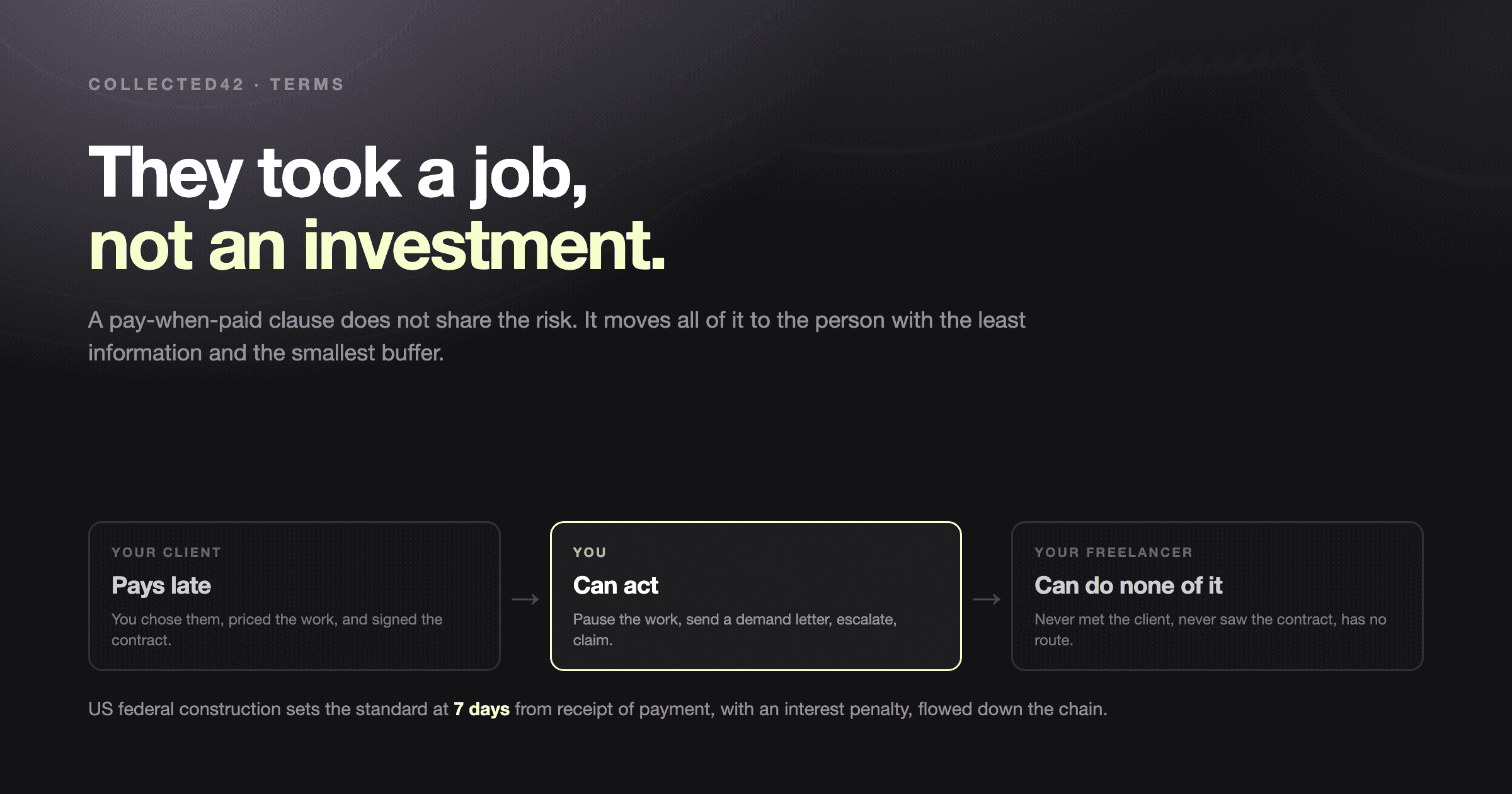
A freelancer took a job, not an investment. They priced the work without the risk premium a lender would charge, because nobody told them they were lending. That is the whole argument, and it survives every version of the cash flow excuse.
What a conditional payment clause actually does
Some agencies put a term in their freelancer agreements saying payment is due once the client has paid. It feels like fairness, since the risk is simply passed along the chain to whoever is closest to the work.
It does not share the risk. It moves the entire risk onto the person with the least information, the least ability to assess the client, and the smallest buffer. Your freelancer never met the client, never saw the contract, and cannot pause the work or send a demand letter. You can do all 3.
It also quietly changes what you sold. You bid for the project on the basis that you would manage it, including the commercial risk. A clause moving that risk to a contractor means you kept the margin for carrying a risk you then declined to carry.
What the law makes of it
These clauses have been fought over most in construction, where they are endemic, and the direction of travel is consistent. The rules below are industry-specific and do not govern an ordinary freelance agreement, but they show how conditional payment is regarded where legislators have looked at it closely.
In the US, federal construction contracts set a clear standard. FAR 52.232-27 requires the prime contractor to pay a subcontractor for satisfactory performance not later than 7 days from receipt of payment, with an interest penalty for payments not made on time, and requires that obligation to be flowed down to lower tiers. Outside federal work the position varies by state, and several states treat pay-if-paid clauses as void or unenforceable, so your own state is worth checking before relying on one.
In the EU, the Late Payment Directive's limits apply to what you owe as well as what you are owed. The European Commission's guidance on late payment is that businesses pay within 60 days unless they expressly agree otherwise and the arrangement is not grossly unfair. A clause with no payment date at all, contingent on a third party, is the kind of term that invites that test.
In the UK, Parliament settled it for construction outright. Section 113 of the Housing Grants, Construction and Regeneration Act 1996 provides that a provision making payment conditional on the payer receiving payment from a third person is ineffective, with a narrow exception where that third person becomes insolvent. The exception is instructive: the only situation the law accepts is the 1 where the money genuinely will not arrive at all.
When you genuinely cannot pay
Sometimes the money is not there. That is a real situation and it has better and worse versions, separated almost entirely by communication.
Approach | What it does to the relationship | What it does to you |
|---|---|---|
Pay in full, on time | Nothing. It is simply normal | Costs you reserves, buys you everything |
Tell them early, part pay, give a date | Survivable, often strengthens it | Costs an awkward conversation |
Go quiet and pay late | Serious damage, usually permanent | Costs you the freelancer and the referrals |
Invoke a conditional clause | Ends it, and the story travels | Costs your reputation in a small market |
The gap between rows 2 and 3 is where most of the harm happens, and it costs nothing but discomfort to stay on the right side of it. Freelancers talk to each other, and the good ones have a choice about whose work they take.
Pay part of it if you cannot pay all of it. A freelancer who receives 40% on the due date with a date for the rest is in a very different position from one who receives silence, both practically and in how they will describe you later.
The message to send
Before the due date, not after. Specific, and without a lecture about your client:
Subject: Your invoice #42 — paying on [date]
Hi [Name],
Your invoice for [amount] is due on [date] and I want to flag ahead of time that I'll be a few days late on part of it.
I'll send [amount] on the due date as planned, and the remaining [amount] on [specific date]. That date is firm, and it doesn't depend on anything outside my control.
I'm sorry for the inconvenience. It won't affect anything we've agreed for [next project], and if the timing causes you a problem, tell me and I'll work round it.
Thanks,
[Name]
What makes this acceptable is the second paragraph. A firm date that does not depend on your client is a commitment; a date conditional on someone they have never met is a warning. Do not explain the client's behaviour in detail, because it reads as groundwork for a later excuse, and it is not their problem.
Match what you owe to what you are owed
The structural fix is unglamorous and it works: line your payable terms up with your receivable ones, so you are never funding the gap out of nothing.
Agree freelancer terms that sit behind client terms. Where clients pay on net 30, paying contractors on net 30 from their invoice date rather than on receipt leaves you a working margin without pushing risk onto them.
Take a deposit on the project and use it to fund the first contractor invoices. That is what the deposit is for.
Stage the client billing so money arrives as the cost is incurred, which is the whole argument in milestone billing.
Hold a buffer sized to 1 month of contractor costs. It is the cheapest insurance an agency can hold and it removes this entire conversation.
See it coming. A 13-week forecast shows the week you cannot cover payroll while there is still time to collect, defer or borrow.
Agencies that never have this problem are rarely the ones with better clients. They are the ones whose money comes in before it goes out, by design rather than by luck.
The 1 case where it changes
If the client becomes insolvent, the money is genuinely not coming, and that is the single situation the UK statute carves out. It does not transfer the obligation to your freelancer automatically, because your contract with them stands on its own, but it does change the conversation from a timing problem to a loss that has to be allocated.
Deal with it directly and early. Tell them what has happened, pay what you can, and be honest about the rest. The steps that follow are in what to do when a client goes insolvent, including the part where you stop collecting and file a claim.
Where the client is late rather than failing, it is a timing problem and it is yours. The routes are pausing the work and the ordinary escalation, not pushing the delay onto the person who did the work.
FAQ
Do I have to pay freelancers if my client hasn't paid me?
Yes, unless your contract with them genuinely says otherwise. Their agreement is with you, not your client, and your client's payment behaviour is not a term of it. Pay on the agreed date and recover the position from the client separately.
Can I put a pay-when-paid clause in my freelance contracts?
You can try, but it is poor practice and in some places unenforceable. Several US states treat pay-if-paid clauses as void in construction, and UK legislation makes them ineffective in construction contracts except where the third party is insolvent. Check your own position, then consider whether you want to be the agency that uses one.
What if I genuinely can't pay on time?
Tell them before the due date, pay part of it, and give a firm date for the rest that does not depend on your client. That is survivable. Silence followed by a late payment is what ends relationships.
Should I explain that my client is late?
Briefly, and without detail. A short reason is fine. A full account of your client's behaviour reads as preparation for a longer delay, and the freelancer has no way to act on it.
What if the client has gone insolvent?
The money may genuinely not arrive, which changes the situation from timing to loss. Your obligation to the freelancer still stands on its own terms, so be direct about it early, pay what you can, and take advice on the rest.
How do I avoid this happening again?
Line up your payable terms with your receivable ones, fund early contractor costs from a deposit, bill the client in stages, and hold roughly a month of contractor costs as a buffer. A 13-week cash forecast will show the squeeze before it arrives.
Not legal advice. The enforceability of conditional payment clauses varies by state, by country and by industry, and the provisions cited above are specific to construction contracts. Have your own contracts reviewed before relying on any term.