The short answer
Invoice finance converts an unpaid invoice into cash now, at a cost, and sometimes at the price of your client finding out. It solves a timing problem and it solves nothing else.
Work out the real annualised cost, which is rarely the headline rate.
Check whether your client will be notified, because that is a commercial decision rather than a financial one.
Check who carries the loss if the client never pays.
Compare it honestly against collecting faster, which is free.
Arrange it before you need it. The terms are worse when you are desperate.
Used deliberately for a known gap, it is a reasonable tool. Used to paper over slow collection, it converts a payment operations problem into a permanent cost of doing business.
The 3 products, and the difference that matters
The names are used loosely, and the distinction worth understanding is whether your client is told.
Product | What it covers | Does the client find out? |
|---|---|---|
Factoring | Usually your whole sales ledger | Yes. The lender collects, in their name |
Invoice discounting | Usually the whole ledger | Normally not. You still collect |
Selective or spot finance | Individual invoices you pick | Depends on the facility |
Factoring hands the collection function to the lender, which is why it is the cheapest to administer and the most visible. Discounting leaves you collecting, so the client sees nothing different, and the lender is relying more heavily on you, which is why it is normally offered to larger or more established businesses.
For a small agency the selective version is usually the right starting point. You finance the 1 large invoice causing the squeeze rather than committing the whole ledger, and you keep the option of not using it next month.
Your client may be told to pay someone else
This is the part agencies underestimate, and it is worth understanding mechanically rather than as a vague worry.
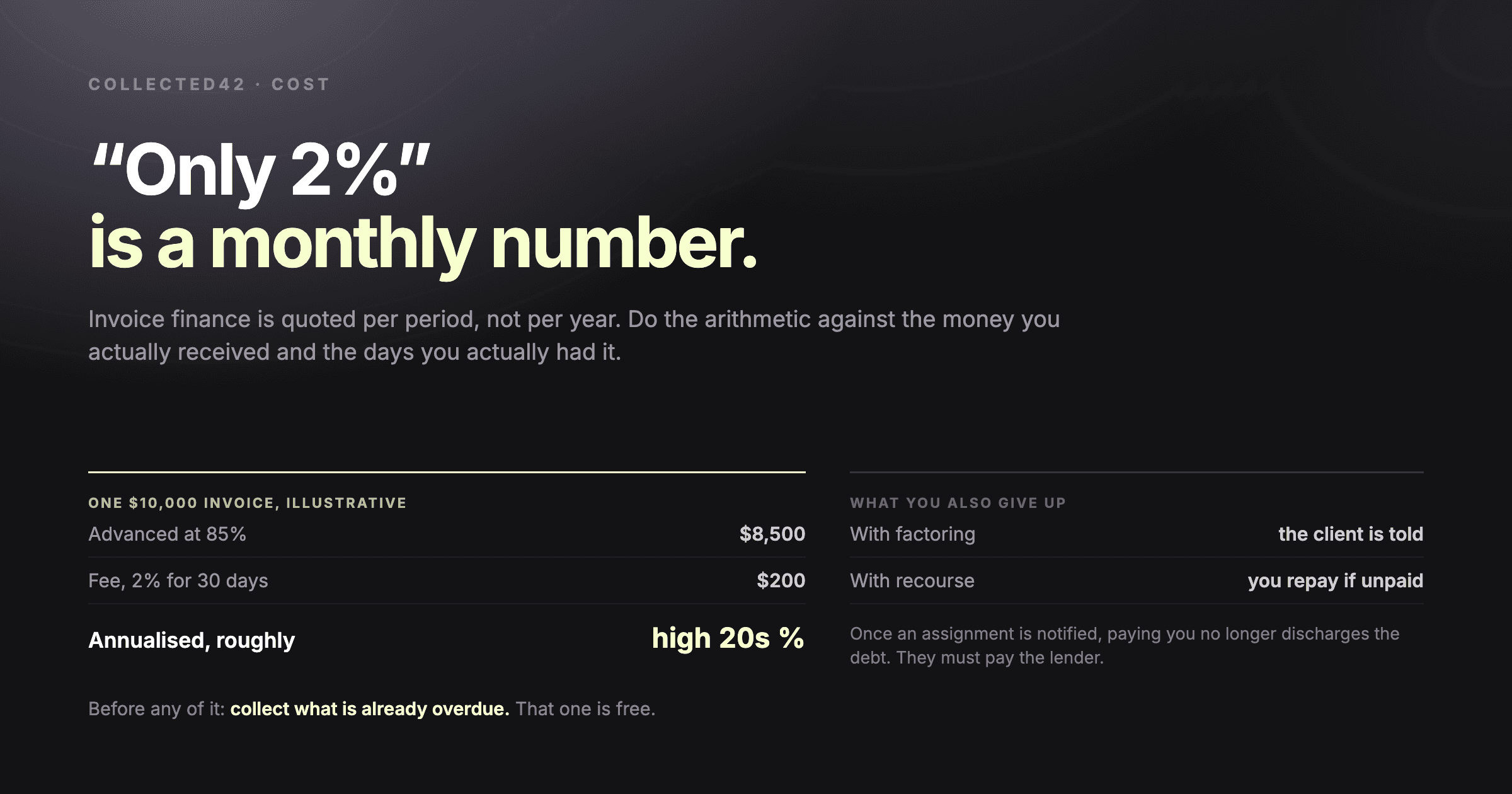
In the US, UCC section 9-406 provides that the party owing the invoice may keep paying the original supplier until it receives notification that the amount due has been assigned. After that notification, it discharges the obligation by paying the assignee, and paying the assignor no longer discharges it. In plain terms: once your client has been notified, they must pay the finance company, and paying you no longer counts.
So with a disclosed facility, your client receives a formal instruction to send money elsewhere. Some clients read that as ordinary corporate finance and think nothing of it. Others read it as a signal that you are short of cash, and procurement teams at larger companies do notice. Decide how yours will read it before you sign, because it cannot be unsent.
Undisclosed facilities avoid this, and cost more or are harder to obtain for exactly that reason.
Who carries the loss
The second question to settle is what happens if the invoice is never paid at all.
With recourse, you repay the advance if the client does not pay. The lender has financed your timing, not your credit risk, and you still own the problem.
Without recourse, the lender absorbs an agreed set of losses, usually only where the client becomes insolvent rather than merely refuses. It costs more, and the exclusions are where the detail lives.
Read the non-recourse exclusions closely. Protection that disappears the moment the client raises any objection to the work is worth considerably less than it sounds, because a disputed invoice is the common way an invoice goes unpaid. Insolvency-only cover is still useful, but know which you have bought.
What it actually costs
Facilities quote a discount rate for the period the invoice is outstanding, plus a service fee, and sometimes arrangement or minimum-usage charges. The headline number is per period rather than per year, which makes the comparison misleading unless you do the arithmetic.
An illustration with round figures. A $10,000 invoice, 85% advanced, 2% charged for a 30-day period. You receive $8,500 now and pay $200 for the use of it. That is roughly 2.4% for a month on the money you actually got, which annualises to something in the high 20s. The true figure for your own facility depends on the advance rate, the fee structure and how long invoices really take to pay.
Run it against the alternative rather than against zero. If the same $10,000 would have arrived 20 days later without financing, you are paying $200 for 20 days, and whether that is good value depends entirely on what those 20 days let you do. Covering payroll is worth it. Smoothing a gap you could have forecast is usually not, which is what a 13-week forecast is for.
Can a client stop you using it?
Historically clients put anti-assignment clauses in contracts, which blocked suppliers from financing those invoices. Both the US and the UK have legislated against that.
In the US, the same UCC provision makes a term ineffective to the extent it prohibits, restricts or requires the client's consent to the assignment of an account. In the UK, the Business Contract Terms (Assignment of Receivables) Regulations 2018 provide that a term has no effect to the extent that it prohibits or imposes a condition or restriction on assigning a receivable, with exclusions including suppliers that are large enterprises, financial services contracts and several specific contract types.
In the EU there is no equivalent harmonised rule, so assignment is a matter of national law and of the contract in front of you. Check both before assuming an invoice can be financed.
A clause being ineffective does not make the conversation comfortable. Where a client has asked for an anti-assignment term, consider whether you want to be the supplier who relies on a statute to override it.
The cheaper things to try first
Invoice finance is a permanent cost attached to a recurring problem. Before taking it on, work through the options that cost nothing:
Collect what is already overdue. The fastest cash in most agencies is an invoice 3 weeks late that nobody has followed up. It costs a phone call.
Bill in stages so money arrives as the cost is incurred, which is the argument in milestone billing.
Take a deposit, which funds the start of a project without a fee attached. See how to introduce one.
Shorten the terms on new work rather than financing the old terms indefinitely.
Arrange an overdraft, which is often cheaper than invoice finance for a short, occasional gap.
The honest test: if you would still need the facility after collection improved, it is a financing decision. If it exists because invoices sit untouched for weeks, it is a follow-up problem that you are paying interest to avoid solving.
FAQ
What is invoice finance?
An arrangement where a lender advances most of the value of an unpaid invoice immediately and takes a fee, settling up when the client pays. Factoring and invoice discounting are the common forms, differing mainly in whether the client is told and who does the collecting.
Will my clients know I am using it?
With factoring, yes. Once an assignment is notified, your client must pay the finance company rather than you, and paying you no longer discharges the debt. Invoice discounting is normally confidential, and usually harder to obtain.
How much does invoice finance cost?
Quotes are usually a discount rate for the period plus a service fee, which understates the annual cost. Work out what you pay against the amount you actually received and the days you had it. A couple of per cent for 30 days annualises to a far larger number.
What is the difference between recourse and non-recourse?
With recourse, you repay the advance if the client never pays. Without recourse, the lender absorbs agreed losses, typically limited to client insolvency rather than disputes. Read the exclusions, because a disputed invoice is a common way an invoice goes unpaid.
Can a client prevent me from factoring their invoices?
Usually not in the US or the UK, where legislation makes most anti-assignment terms ineffective, though the UK regulations carry exclusions. In the EU it depends on national law and on the contract. Check before you rely on it.
Is invoice finance a good idea for a small agency?
For a known, time-limited gap, it can be. As a standing arrangement it is an expensive substitute for collecting on time, taking deposits and billing in stages. Try the free options first and keep the facility for the situations they do not cover.
Not legal or financial advice. Invoice finance terms, assignment rules and the treatment of anti-assignment clauses vary by state, country and contract. Take advice on any facility before signing.