The short answer
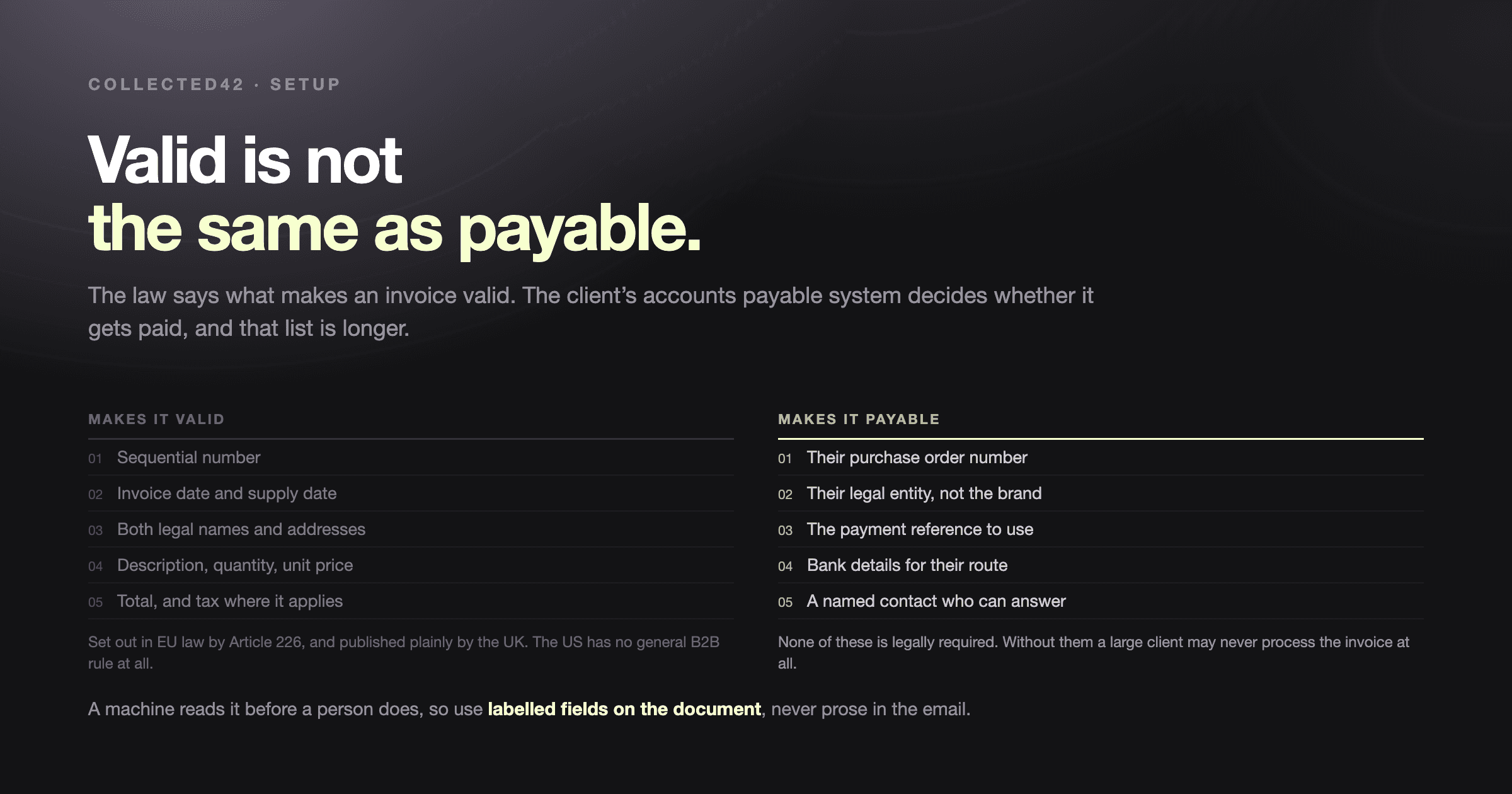
There are 2 lists, and most agencies only know the first. The law tells you what makes an invoice valid. The client's accounts payable system decides whether it gets paid, and that list is longer.
Get the legally required particulars right, which is a short and well-defined set.
Then add the items their system needs to match it, which is where invoices actually fail.
Use your registered legal name and theirs, not the names on the website.
Number invoices sequentially, with no gaps.
Put everything in labelled fields on the document itself, not in the covering email.
An invoice is a document that has to satisfy a tax authority, a matching routine and a human, in that order of strictness and the reverse order of attention.
The elements, and what breaks without each
Element | Why it exists | What happens if it is wrong |
|---|---|---|
Unique sequential number | Audit trail, and your own reference | Payments arrive unallocated |
Invoice date | Starts the payment clock | Arguments about whether it is overdue |
Supply date | When the work was done | Tax period errors, and queries |
Your full legal name and address | Identifies the supplier of record | Fails the supplier record check |
Their full legal entity name | Identifies the buyer | Rejected for the wrong company |
Description, quantity, unit price | What is being charged for | Manual review instead of automatic match |
Total, and tax if applicable | The amount payable | Partial payment or a query |
Purchase order number | Matches to their authorisation | Silently fails the 3-way match |
The last row is the one that costs the most and appears on no legal list. A purchase order number is not required for an invoice to be valid, and without it a large client may never process the invoice at all, for the reasons in the PO piece.
The US has no general rule, which is its own problem
For ordinary business-to-business work in the US there is no federal statute setting out what an invoice must contain. You can bill on a napkin and it is a valid claim.
That freedom is less useful than it sounds, because the standard is set by whoever is paying. The clearest published model is the one the federal government applies to its own suppliers: a proper invoice has to carry the contractor's name and address, the invoice date and number, the contract number including order and line item numbers, a description with quantity, unit of measure, unit price and extended price, the payee's name and address, and a contact for questions.
Copy that list even when you are not selling to the government, because large corporate buyers run on much the same logic and it is the version that matches cleanly. It also travels well, which matters if you ever invoice a public body.
The EU has the definitive list
Where VAT applies, Article 226 of the VAT Directive sets out the particulars an invoice must carry, and it is worth reading once rather than guessing. Among the required items are the date of issue, a sequential number based on one or more series that uniquely identifies the invoice, the VAT identification numbers of supplier and customer, the full names and addresses of both parties, the quantity and nature of the services rendered, the date of supply, the taxable amount per rate, the unit price exclusive of VAT, the rate applied and the VAT payable.
The same article requires a note where a special arrangement applies, such as reverse charge, and a reference to the relevant provision where a supply is exempt. For an agency invoicing across borders, that reverse charge note is the item most often missed, and it belongs with the rest of the cross-border setup in getting paid by a client in another country.
And the UK publishes a plain version
The UK government's guidance lists what an invoice must include: a unique identification number, your company name, address and contact information, the company name and address of the customer, a clear description of what you are charging for, the date the service was provided, the date of the invoice, the amounts being charged, VAT where applicable, and the total owed.
It adds 2 specifics worth knowing. A limited company must use its full registered name as shown on the certificate of incorporation, and if you name any directors on the invoice you have to name all of them. Sole traders include their own name alongside any trading name, and an address where legal documents can be served.
The items that are not required and decide everything
Nothing on the lists above gets you paid by a large organisation on its own. These do:
The purchase order number, labelled exactly as they label it.
Their legal entity, which is frequently not the brand you work with. Groups run several registered companies and an invoice to the wrong one fails even though everyone knows who you are.
The payment reference you want used, stated as such, so the money arrives matched rather than sitting unallocated.
Complete bank details for the route they will use, plus a payment link where you offer one, as in how clients should pay you.
A named contact with a direct address, so a question comes to you rather than stopping the invoice.
Expenses itemised separately with receipts attached, per billing expenses.
Format, because a machine reads it first
Accounts payable increasingly processes invoices automatically, and an automated reader looks for labelled fields rather than sentences. 4 habits make the difference:
Put everything on the invoice document, never only in the email. The attachment is what gets filed and forwarded.
Label fields plainly. Invoice number, PO number, due date. Not clever headings, not design-led omissions.
Send a text-based PDF rather than a scan or an image, so the text can be read without optical recognition.
Keep the layout identical every time. A finance team that has processed 6 of your invoices will process the seventh without thinking, and every redesign resets that.
That last point is worth more than it sounds, and it is the reason to resist making the invoice an expression of the brand.
Numbering, properly
Sequential, unique, no gaps. The EU requires a sequential number that uniquely identifies the invoice, and auditors in most places treat a gap as a missing invoice rather than as a deleted draft.
So avoid deleting invoices. Cancel or credit them instead, keeping the number in the series. Avoid restarting the sequence each year unless the format makes the year explicit, and avoid per-client sequences, which make your total volume hard to reconcile and look improvised.
FAQ
What should an invoice include?
A unique sequential number, the invoice date and supply date, your full legal name and address, the client's legal entity name and address, a clear description with quantities and unit prices, the total, and tax where it applies. Then add their purchase order number and your payment reference, which are what actually get it paid.
Is there a legal requirement for what goes on a US invoice?
Not generally, for business-to-business work. The practical standard is set by the buyer, so copying the federal proper invoice definition is a reliable default because large corporate systems work in much the same way.
What must be on a VAT invoice in the EU?
Article 226 of the VAT Directive sets the list, including a sequential number, both parties' VAT identification numbers, names and addresses, the nature and extent of the services, the date of supply, the taxable amount per rate, the rate and the VAT payable, plus a note where reverse charge applies.
Do I have to use my registered company name?
In the UK a limited company must use its full registered name as on the certificate of incorporation. Elsewhere it is good practice regardless, because supplier records and purchase orders are matched against the legal entity rather than the trading name.
Can I skip invoice numbers or start again each year?
Avoid gaps, since an auditor is likely to read one as a missing invoice. Cancel or credit rather than deleting, and if you restart annually make the year part of the format so the series stays unambiguous.
Does the invoice design matter?
Less than its consistency. Automated processing looks for labelled fields, so plain labels and an identical layout each time beat a distinctive one. Send a text-based PDF rather than an image.
Not tax or legal advice. Invoice requirements depend on your country, your registration status and the nature of the supply. Confirm your own obligations with an accountant.