The short answer
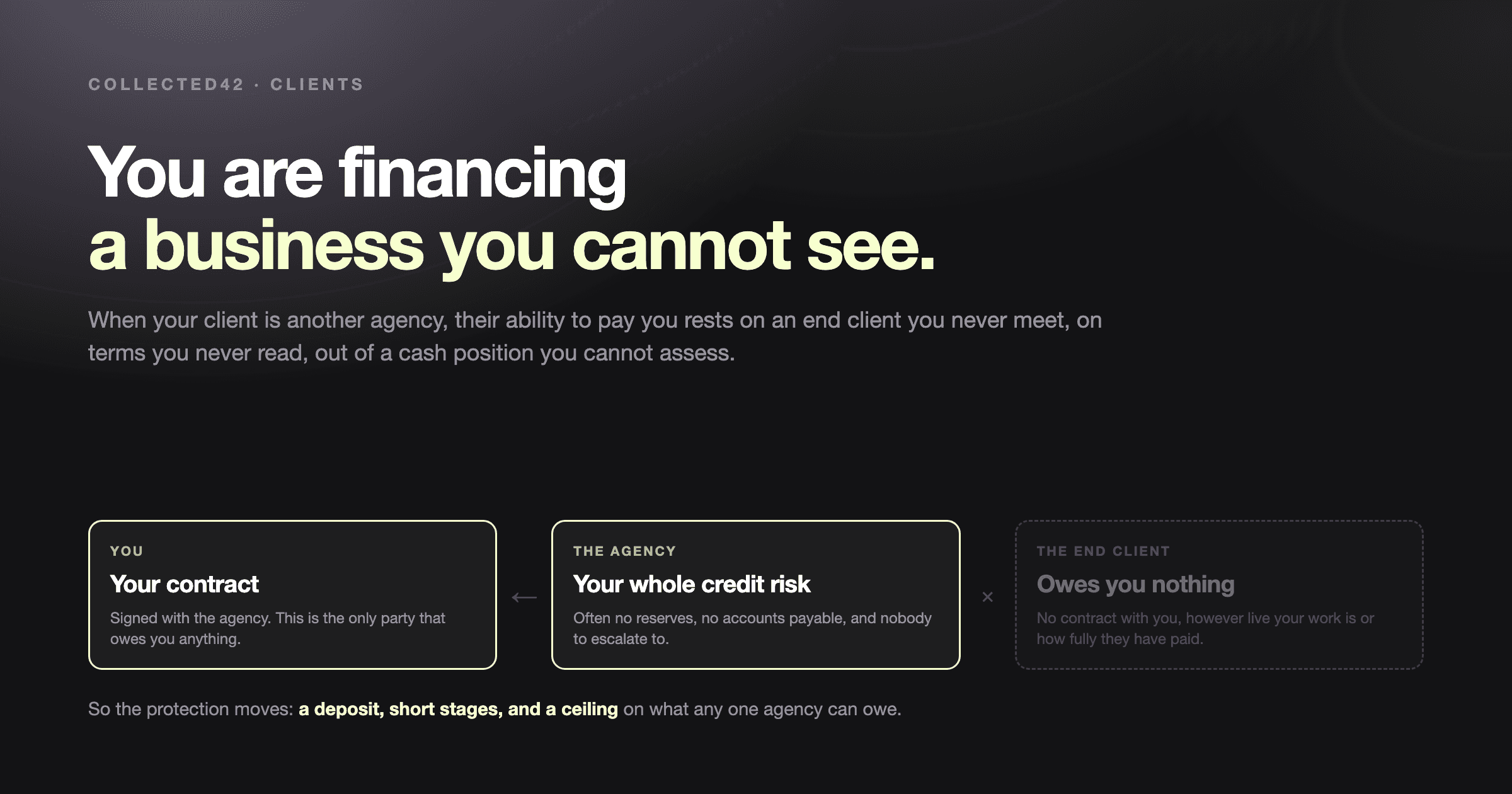
When your client is another agency, you are financing a business you cannot see. Their ability to pay you depends on an end client you never meet, on terms you never read, out of a cash position you cannot assess.
Establish before you start whether their payment to you depends on their client paying them.
Take a deposit, which matters more here rather than less.
Invoice in stages, so the exposure never gets large.
Remember your claim is against the agency that hired you, and nobody else.
Watch the first invoice closely, because it tells you most of what you need to know.
None of this makes agency clients bad work. They are often the best work: fewer approval layers, people who understand the craft, and no procurement portal. The risk sits in a different place, so the protections go in a different place.
Why this is a different situation
The standard advice for a late invoice assumes a client with a finance function. Much of it stops working when your client is 9 people above a bakery.
What usually helps | Why it fails here | What to do instead |
|---|---|---|
Escalate to accounts payable | There is no accounts payable | Go to the founder, who already knows |
Go around your contact | Your contact may be the whole company | Nothing to go around |
Check their payment record | Too small to appear anywhere public | Ask other suppliers, and watch invoice 1 |
Point at their process | There is no process to point at | Agree dates, in writing, in advance |
The second difference is informational. With a direct client you can see the project, the budget and the approvals. Here you see a brief, and the economics behind it, including whether the end client has paid a deposit, are invisible unless you ask.
The third is structural. A small agency usually has no reserves, so a single late payment from their biggest client arrives at you within days. That is the mechanism described in paying your own freelancers, seen from the receiving end.
Establish 4 things before you start
Does your payment depend on theirs? Ask directly: are you paying me on these terms regardless, or when your client pays you? The answer changes everything and most agencies will tell you honestly.
Who is the end client, and is the work already sold? Work done for a pitch is a different risk from work on a signed contract, and the difference is rarely volunteered.
What are their terms with the end client? If they are on net 60 and offering you net 30, they are carrying the gap, which is a good sign. If they will not say, that is information too.
Will your name appear anywhere? Not a payment question directly, but it tells you whether you are a supplier or a secret, and secrets have less recourse.
Ask these at the start, when the questions are routine, which is the same argument as any other payment onboarding. Asking them in month 3 reads as suspicion.
Pay when paid, from this side
Plenty of agency-to-agency arrangements make your payment conditional on their client paying them. Sometimes it is written into the contract, more often it is simply how things turn out.
Treat a conditional term as a price, rather than as an insult. If you are being asked to carry the risk of a client you cannot assess, that is financing, and financing has a cost. Either the term goes, or the rate reflects it, or you take a larger deposit so that the amount at risk is smaller.
Worth knowing that the law is unsympathetic to these clauses where it has looked at them. In UK construction contracts, section 113 of the Housing Grants, Construction and Regeneration Act 1996 makes a provision conditioning payment on the payer being paid by a third person ineffective, except where that third person is insolvent. That does not govern your contract, but it tells you how the arrangement is regarded where legislators have examined it.
For a positive benchmark, US federal contracts require a prime to pay a subcontractor not later than 7 days from receipt of payment, with an interest penalty, flowed down the chain. That is a reasonable thing to propose: not payment conditional on their client, but payment promptly once their client pays, with a backstop date if that never happens.
Who you can actually claim against
This is the part that surprises people when a project goes wrong. Your contract is with the agency, and the end client has no obligation to you.
Cornell's definition of privity captures it: parties in privity are bound by the contract and obligated to each other, and it is those parties who can pursue remedies for breach. The end client never agreed anything with you, so in the ordinary case they owe you nothing, even where your work is sitting on their website and they have paid for it in full.
Which means the agency's solvency is your entire credit risk. If they fail, you are 1 unsecured creditor among several, in the position described in what to do when a client goes insolvent, and the money the end client paid them is gone into the general pot.
Should you contact the end client?
Occasionally the thought arrives that the end client would pay you directly, or would at least apply pressure. It is almost always a bad move and sometimes a contractual breach.
Most agency agreements include a non-solicitation or confidentiality term covering exactly this, so check before doing anything. Beyond the contract, the market is small and the story travels: an agency that hears you went around them will not hire you again, and will tell others.
The exceptions are narrow. Where the agency has gone silent entirely and you believe they are failing, where your contract permits it, or where the end client is already aware of you and the relationship is open, a careful enquiry may be reasonable. Take advice first, and put it in writing to the agency that you intend to do it, since a surprise is what makes this unforgivable.
The better route is usually the ordinary one: a clear demand letter to the agency, with a deadline, and a decision after it.
Protecting yourself structurally
Because the diagnostic tools are weaker here, the structural ones matter more:
Take a deposit on every engagement. With a direct client it improves cash flow. Here it also caps the loss, which is a different and better reason. How to ask.
Bill in short stages. Monthly or fortnightly rather than on completion, so the exposure never exceeds what you can absorb, as in milestone billing.
Set a ceiling per agency client. Decide in advance the most you will let any 1 of them owe, and treat crossing it as a stop rather than a worry.
Stop early rather than late. A missed stage payment is the signal. The suspension clause matters more when your client has no reserves.
Keep your own records of what you delivered and when, since an agency in trouble may not have them and you may need to prove the work.
Watch the first invoice above everything else. An agency that pays invoice 1 on time, without being asked, is telling you something more reliable than any reference. One that needs a reminder on the smallest invoice of the relationship is also telling you something.
When it works well
Worth saying plainly: agency-to-agency work is often excellent, and a good relationship here is among the most valuable things a small studio can have. Repeat work, no pitching, people who brief properly.
The ones that work share a pattern. The agency pays you on its own terms regardless of its client, tells you early when something is slipping, and treats your invoice as its obligation rather than as a pass-through. That is the standard you are looking for, and it is also the standard to hold yourself to when you are the one hiring.
FAQ
Should I accept a pay-when-paid clause from another agency?
Only with a price attached, or a backstop date, or a deposit large enough to cap the loss. You are being asked to carry the credit risk of a client you cannot assess, which is financing rather than a payment term.
Can I invoice the end client if the agency does not pay me?
Generally no. Your contract is with the agency, and under ordinary contract principles only parties to a contract can enforce it. The end client owes you nothing even where your work is live and they have paid in full.
Should I contact the end client to apply pressure?
Rarely, and check your contract first, since non-solicitation and confidentiality terms usually cover it. The market is small and going around an agency ends the relationship and damages your reputation. Use a demand letter to the agency instead.
How do I check whether another agency pays reliably?
They are usually too small to appear in public payment data, so ask other freelancers and studios who have worked with them, and treat the first invoice as the real test. Prompt payment of invoice 1, unprompted, is the best signal available.
What if the agency goes under owing me money?
You are an unsecured creditor of that agency, and the money its client paid is part of the general pool. File a claim, stop work, and treat the remainder as a write-off decision. Deposits and short billing stages are what limit this in advance.
Is agency-to-agency work worth it?
Often yes. The work is usually better briefed and there is no procurement to navigate. The risk simply sits in a different place, so the protection goes into deposits, short stages and a ceiling rather than into credit checks.
Not legal advice. Contract rights, privity and the enforceability of conditional payment terms vary by state and country, and the provisions mentioned here are specific to the contexts named. Have your own agreements reviewed.