The short answer
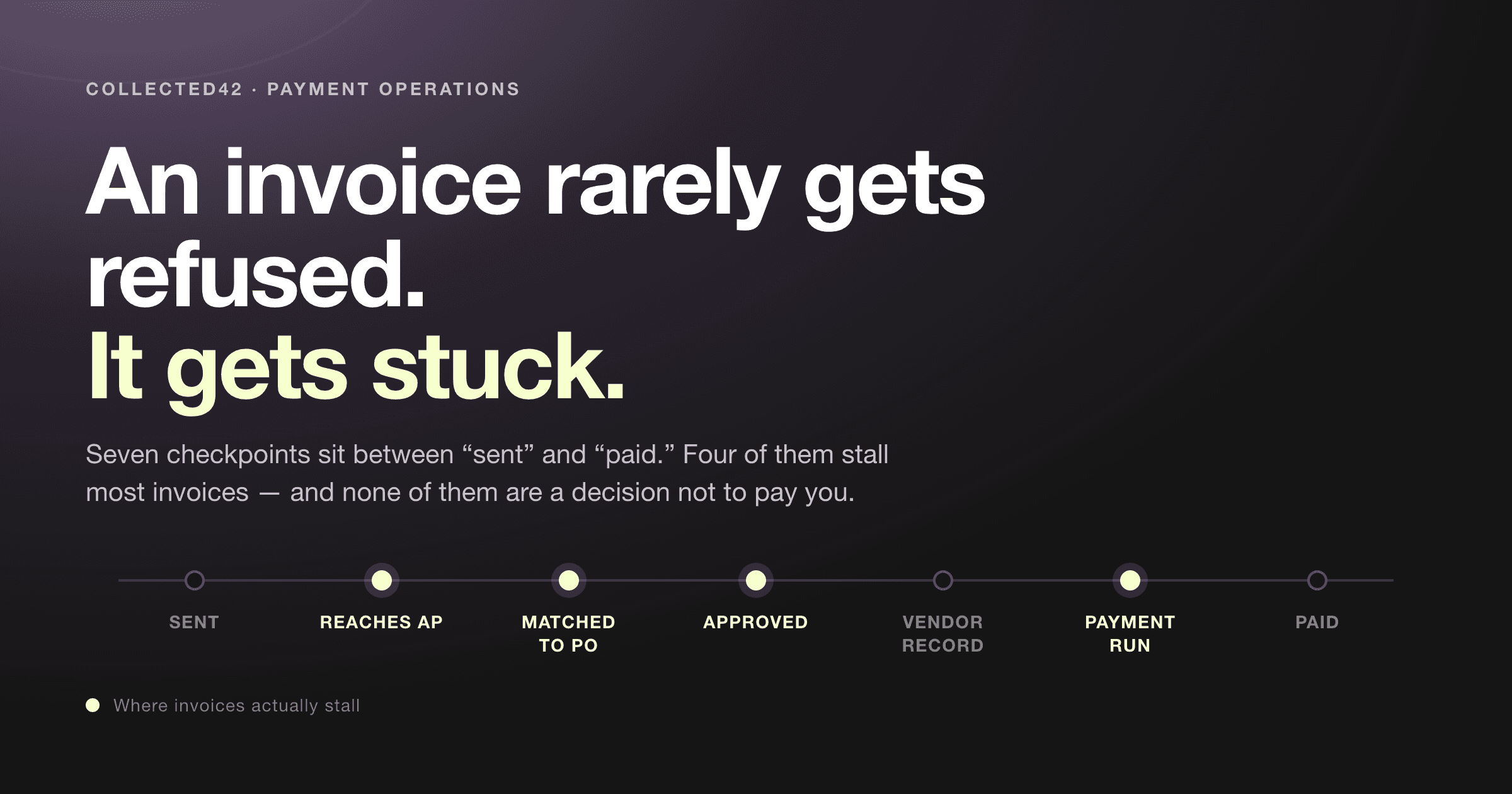
Clients pay late for seven reasons, and only one of them is “they don’t want to pay.” In order of how often they occur:
The invoice was never approved internally.
There is no purchase order, or the PO does not match the invoice.
You are not fully set up as a vendor in their system.
The invoice is sitting in a payment run you do not know about.
You billed the wrong legal entity, address, or inbox.
Your contact left, or never owned payment in the first place.
They genuinely cannot pay right now.
Six of those seven are administrative. They are not decisions, and they will not resolve because you sent a firmer reminder — they resolve because somebody found the blocker and cleared it.
That is the single most useful reframe in this whole subject: an overdue invoice is usually an ownership problem, not a collections problem. Below is how to identify which of the seven you are looking at, and what actually fixes it.
1. The invoice was never approved
The most common reason by a distance. Your invoice arrived, was forwarded to someone for sign-off, and that person is on leave, overloaded, or unaware it is waiting on them. Nothing is wrong with the invoice. It is simply parked.
What it looks like
Your contact says the invoice was “passed on” but cannot say to whom. Nobody disputes anything. There is no date.
The fix
Stop asking for an update and ask a question with a factual answer: “Has invoice #214 been approved for payment, and if not, who is it waiting on?” The name is what you need. Once you have the approver, you have someone to follow up with who can actually act.
More on shifting from updates to dates in our guide to following up without sounding desperate.
2. There is no PO, or the PO does not match
Many mid-size and enterprise clients cannot pay an invoice that is not matched to an approved purchase order. If the PO was never raised, or the invoice total exceeds the PO by even a small amount, the invoice fails matching and sits in an exceptions queue. Often nobody tells you.
What it looks like
Silence after a clean delivery, from a client large enough to have a procurement function. Or a request to “re-send the invoice” with no explanation of what was wrong with the first one.
The fix
Ask directly: “Is a PO required for this, and has one been raised?” If the amounts do not match, ask whether they need a revised invoice or an amended PO — the answer differs by company, and guessing wastes another cycle.
This is fundamentally a prevention problem. Asking about PO requirements before kickoff takes two minutes and removes the failure entirely — one reason introducing a deposit is useful beyond the cash, since it surfaces procurement friction while you still have leverage.
3. You are not set up as a vendor
Before a company can pay you, you usually have to exist in their finance system: bank details verified, tax forms filed, sometimes an entire supplier onboarding process completed. On procurement platforms like Coupa or SAP Ariba, that can mean creating a supplier account and submitting documentation.
What it looks like
A first invoice to a new enterprise client that goes quiet. Requests for tax forms or bank verification that arrive weeks after you invoiced.
The fix
Start vendor onboarding at kickoff, not at invoice time. Ask: “Is there a vendor onboarding process on your side, and can we begin it now?” Then chase that with the same discipline you would chase an invoice, because it is the same problem — just earlier, and far cheaper to solve.
4. It is sitting in a payment run you do not know about
Most accounts payable departments do not pay invoices as they arrive. They pay in batches — weekly, fortnightly, or monthly. If your invoice was approved on the 3rd and the run is on the 25th, it is not late in their mind. It is scheduled.
What it looks like
An approved invoice, no dispute, no urgency from anyone, and no payment.
The fix
Ask which payment run it is in. This single question converts an anxious guess into a date you can plan around, and it is the question that most distinguishes someone who has done this before from someone chasing blindly.
Ask it at onboarding too, so you know each client’s cadence before you ever need it. Chasing on the 3rd when the run is on the 25th only teaches them to ignore you.
5. You billed the wrong entity, address, or inbox
The company you talk to and the company that pays you are often not the same legal entity. Group structures, holding companies and regional subsidiaries all cause this. AP systems match on registered names, so “Northwind” instead of “Northwind Media LLC” can be enough for an invoice to fail intake.
What it looks like
Total silence — no bounce, no acknowledgement. Your invoice reached a general inbox nobody monitors, or a system that rejected it without notifying you.
The fix
Confirm three things: the exact legal entity to bill, the invoices email address, and whether submissions must go through a portal. Then re-issue, correctly addressed, and ask for confirmation of receipt rather than assuming.
6. Your contact left, or never owned payment
The person who hired you may have no authority over payment at all. Their job ended at approving the work. If they have also left the company, your invoice is not being ignored — it is orphaned.
What it looks like
Vague reassurance that goes nowhere. “Finance is handling it” with no name attached. Or emails that simply stop being answered.
The fix
Get out of the middle. Ask to be introduced to whoever owns payment, framed as removing a burden rather than escalating: “Could you introduce me to the person handling this? I’ll coordinate with them directly so you don’t have to stay in the middle.”
That phrase does a lot of work, and there is a full breakdown of it in what to do when a client says finance is handling it.
7. They genuinely cannot pay
Sometimes the answer really is cash. Small and mid-size firms experience cash flow pressure constantly — the Federal Reserve’s Small Business Credit Survey is a useful window into how common that is.
What it looks like
Apologetic, human responses. Partial payments. Requests for a plan. Crucially, this client engages — they do not go silent.
The fix
Negotiate structure, not sympathy. A written payment plan with dates is worth more than a promise to “sort it soon.” Pause new work at a threshold you decided in advance rather than in the moment. And treat it as information: this client goes on deposit terms next time.
How to tell which one you have
Three questions, in this order, will usually identify the reason within one email:
Has the invoice been approved for payment?
Is anything missing from our side — a PO, a form, vendor setup?
Which payment run is it scheduled for?
Notice that none of them is “can you pay us.” Each one is a process question, and process questions get factual answers. If all three come back clean and payment still does not arrive, you are in reason 7 — or in a genuine dispute, which is a different problem.
If you would rather not compose these yourself, the invoice follow-up email templates cover every stage from pre-due to formal escalation.
The pattern behind all seven
In six of the seven cases, the invoice is stuck at a checkpoint inside an organisation, and no single person has been made responsible for moving it. Your contact thinks their part is done. Finance is waiting on approval. Procurement is waiting on a form. Everyone is behaving reasonably and nothing is happening.
Chasing harder does not fix that. Finding the owner does.
It is worth knowing that some jurisdictions legislate this problem away in specific contexts — payment timelines on US federal contracts, for example, are governed by prompt payment rules. For ordinary commercial work, though, your leverage comes from your contract and your process, not from statute.
Every follow-up should move the process forward: get a contact, get a date, identify a blocker, escalate ownership.
That is what separates payment operations from sending reminders. A fuller walkthrough of the sequence is in what to do when a client hasn’t paid your invoice.
FAQ
Why do clients pay late even when they are happy with the work?
Because satisfaction and payment are handled by different people. Your contact approves the work; finance releases the money. An invoice can be entirely uncontested and still sit unpaid for weeks because nobody has been made responsible for moving it through approval, PO matching and the payment run.
How do I know whether a client is stalling or just slow?
Ask for a specific payment date. A slow client gives you one and usually meets it. A stalling client gives you an update instead of a date, repeatedly. The presence or absence of a concrete date is the clearest signal you will get.
Is it rude to contact accounts payable directly?
No — it is normally what AP prefers. They process vendor invoices for a living, and a supplier who asks precise process questions is easier to deal with than one who escalates emotionally to a relationship manager. Ask your contact for the introduction first as a courtesy.
How long should I wait before following up?
Do not wait. Confirm before the due date that everything is in place, and follow up on the due date itself if payment has not arrived. Waiting three weeks to say something turns an administrative fix into a confrontation.
Can someone else handle this for my agency?
Yes, and separating the roles usually works better than doing both yourself. You stay the client relationship; someone else owns the payment thread. That is exactly what Collected42 does — and if you would rather run the process yourself, the payment operations wiki documents the whole thing.